

 Portuguese
  English
  Spanish
  Russian
  German
  Arabic
  Italian
  French
  Greek
Greek  Polish
  Swedish
 Abstract
The inquiry into whether any standard ceramic mug is suitable for sublimation printing is a frequent and pivotal question for both nascent entrepreneurs and seasoned professionals in the custom printing industry. This article addresses the central question: can ceramic mugs be used for sublimation printing? It establishes that while the answer is affirmative, it is conditional upon a crucial material prerequisite—the presence of a specialized polymer coating. A standard, uncoated ceramic mug lacks the necessary surface properties to bond with sublimation inks, resulting in failed or ephemeral transfers. This comprehensive exploration delves into the underlying science of the sublimation process, elucidating the physicochemical interaction between sublimation dyes and the polyester-based coating under heat and pressure. The analysis extends to the criteria for selecting high-quality sublimation mug blanks, examining factors such as coating uniformity, ceramic grade, and durability. By providing a detailed procedural guide and troubleshooting common issues, this text serves as an authoritative resource, drawing upon a decade of manufacturing expertise to guide readers toward achieving vibrant, permanent, and commercially viable custom mug prints.
Key Takeaways
- Only ceramic mugs with a special polymer coating are suitable for sublimation.
- The coating opens its pores under heat, allowing ink to fuse into the surface.
- High-quality, AAA-grade mugs prevent defects like ghosting and color shifting.
- The question ‘can ceramic mugs be used for sublimation printing’ depends entirely on this coating.
- Proper time, temperature, and pressure are vital for a perfect transfer.
- The final print is permanent, dishwasher-safe, and scratch-resistant.
- Look for a smooth, consistent finish when selecting your sublimation blanks.
Table of Contents
- Step 1: Understanding the Fundamental Question: Why Not Just Any Ceramic Mug?
- Step 2: The Science of the Sublimation Coating: The Indispensable Polymer Layer
- Step 3: Selecting the Right Canvas: A Guide to High-Quality Ceramic Sublimation Blanks
- Step 4: The Sublimation Process Demystified: From Digital Design to Permanent Print
- Step 5: Beyond the Basics: Troubleshooting, Quality Control, and Advanced Applications
- Frequently Asked Questions
- Conclusion
- References
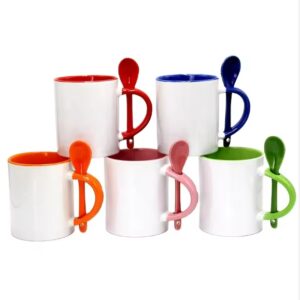
Step 1: Understanding the Fundamental Question: Why Not Just Any Ceramic Mug?
The journey into the world of custom printing often begins with a simple, yet profoundly important, question. It is a question that separates a successful, vibrant creation from a frustrating, faded failure. That question, which we will explore with the depth it deserves, is: can ceramic mugs be used for sublimation printing? The immediate answer is a nuanced “yes,” but this affirmation is tethered to a non-negotiable condition that forms the bedrock of the entire sublimation process on hard surfaces. The ceramic mug in question must be specifically prepared for this process. A standard mug, one you might purchase from a department store or find in a kitchen cabinet, is fundamentally incompatible with sublimation ink. Attempting to sublimate onto such a surface will lead to a pale, blurry, and impermanent image that can likely be wiped away with a thumb. This outcome is not a failure of your equipment or your technique, but a predictable result of a fundamental material incompatibility.
To truly grasp this, we must first appreciate what makes sublimation printing a unique and superior method for customization. It is not merely a surface-level application of ink. Other methods, such as screen printing, pad printing, or the application of vinyl decals, involve laying a layer of ink or material on top of the mug’s glazed surface. While effective for certain applications, these layers are susceptible to the ravages of time and use. They can be scratched, they can peel after repeated washes, and their texture is often palpable, a distinct layer separate from the mug itself. Sublimation, in stark contrast, is a process of infusion. The term “sublimation” describes a phase transition where a substance moves directly from a solid state to a gaseous state, bypassing the liquid phase entirely. In the context of mug printing, specialized sublimation inks are printed onto a transfer paper. When subjected to the precise heat and pressure of a mug press, these solid inks transform into a gas. This gas then permeates the surface of the mug, and as the mug cools, the ink returns to a solid state, but it is now permanently embedded within the surface. The design is not on the mug; it has become a part of the mug itself. This infusion is what gives sublimated products their signature permanence, their vibrant photographic quality, and their smooth, untouchable finish. The design will not crack, peel, or fade under normal use, and it is completely safe for dishwashers and microwaves.
A Comparative Look at Customization Methods
Let us consider the alternatives to better appreciate the distinctiveness of sublimation. Imagine you are creating a set of custom printed ceramic coffee mugs for a corporate client. Your primary concerns are durability, visual appeal, and brand integrity. You could choose screen printing, a classic method where ink is pushed through a mesh screen onto the mug. This is excellent for simple, one- or two-color logos. The ink layer is thick and durable, but it creates a raised texture. It is also less practical for complex, multi-color, or photographic images due to the complexity of creating multiple screens. Another option is using adhesive vinyl decals. This allows for intricate, full-color designs, but the decal is an external layer. It is vulnerable to peeling at the edges, especially with the heat of a dishwasher. It feels like a sticker because that is essentially what it is. Then there is UV printing, a more modern technique where UV-curable inks are applied to the surface and instantly cured with ultraviolet light. This produces beautiful, detailed images, but like screen printing, the ink sits on the surface and can be susceptible to scratches and abrasion over time.
Sublimation transcends these limitations. Because the ink becomes part of the mug’s coating, the final product retains the original smooth, glossy feel of the ceramic. The images can be astonishingly complex, with millions of colors and subtle gradients, reproducing photographs with breathtaking fidelity. The durability is unparalleled. This is why the initial question, “can ceramic mugs be used for sublimation printing?”, is so critical. The magic of sublimation—its permanence and vibrancy—is entirely dependent on having a surface that can receive the gaseous ink. A standard ceramic mug’s glaze is non-porous and chemically inert in a way that simply repels the ink. The gas may momentarily cloud the surface, but it has nowhere to go, no structure to bond with. It cannot penetrate the hard, vitrified glaze. This is where the all-important polymer coating comes into play, a topic we will dissect in meticulous detail in the next step. It is this coating that turns an ordinary piece of ceramic into a receptive canvas for dye-sublimation art.
| Feature | Dye-Sublimation Printing | Screen Printing | UV Printing | Adhesive Vinyl/Decals |
|---|---|---|---|---|
| Image Quality | Excellent; full-color, photographic, continuous tones. | Good; best for solid spot colors and simple logos. | Excellent; full-color, high resolution, can create texture. | Good; full-color capable but can look like a sticker. |
| Durability | Extremely high; ink is infused into the coating. Dishwasher and microwave safe. | High; ink forms a durable layer but can be scratched or worn over time. | Moderate to High; ink is cured on the surface, can be scratched. | Low to Moderate; susceptible to peeling, scratching, and water damage. |
| Feel of Finish | Perfectly smooth; the image cannot be felt. | Slightly raised; the ink layer is palpable. | Slightly raised; ink layer has a distinct texture. | Raised; the edges of the vinyl are noticeable. |
| Color Limitations | Virtually none; millions of colors possible. | Limited; each color requires a separate screen, increasing cost. | Full CMYK color spectrum available. | Virtually none in the design, but white is often not printable. |
| Ideal Mug Type | Requires a special polymer-coated “sublimation blank.” | Works on most standard ceramic and glass mugs. | Works on a wide variety of materials with proper adhesion promoters. | Works on any smooth, non-porous mug surface. |
| Best Use Case | Personalized gifts, photos, complex logos, full-wrap designs. | Bulk orders of simple, one- or two-color branding. | Detailed, full-color designs, especially on unusually shaped items. | DIY projects, temporary or novelty items, intricate cut-out shapes. |
Step 2: The Science of the Sublimation Coating: The Indispensable Polymer Layer
Having established that a special surface is required, we must now turn our intellectual curiosity toward the nature of this surface itself. What is this “sublimation coating” that acts as the gatekeeper to permanent, high-quality printing? It is not merely a primer or a simple layer of paint. The sublimation coating is a marvel of polymer chemistry, a specifically engineered layer that is designed to perform a remarkable task at a molecular level. This coating is the very soul of a sublimation mug, transforming it from inert ceramic into a dynamic and receptive medium. In our work as an integrated factory and trade company, we have dedicated entire workshops to the perfection and application of this coating, as we understand that every subsequent step in the sublimation process depends on its integrity.
At its core, the sublimation coating is a type of polyester. While we might associate polyester with fabrics for clothing, its properties as a polymer make it uniquely suited for this thermal transfer process. The key lies in the structure of the polymer chains. When this coating is subjected to the high temperatures of a mug press—typically around 180-200°C (350-400°F)—it undergoes a temporary change. The polymer molecules, which are normally in a solid, crystalline, or semi-crystalline state, begin to vibrate and move apart. This thermal agitation causes the polymer to soften and its molecular structure to open up, creating microscopic pores. It is crucial to understand that the coating does not melt into a liquid; rather, it reaches its “glass transition temperature,” a state where it becomes receptive and malleable. It is at this precise moment that the magic happens.
The Molecular Dance of Ink and Polymer
Simultaneously, the solid sublimation dye on the transfer paper, pressed firmly against the mug’s coated surface, has also reached its activation temperature. It sublimates, transforming into a cloud of colored gas. This is where the brilliance of the system reveals itself. The gaseous dye molecules, now free and energetic, are drawn into the open pores of the heated polymer coating. Think of the polymer as a microscopic sponge and the dye as a colored mist. The mist flows into every nook and cranny of the sponge. The pressure from the mug press ensures this transfer is uniform and complete, forcing the gas into intimate contact with the receptive polymer. The process is allowed to continue for a specific duration—a few minutes—giving the dye molecules ample time to penetrate deep into the coating. Then, as the heat is removed and the mug begins to cool, the process reverses. The polymer chains contract, closing the pores and returning to their solid, durable state. As they do, they trap the dye molecules permanently within the polymer matrix. The ink is not sitting on top of the coating; it has been encapsulated within it. It has chemically bonded with the polymer. This is why a properly sublimated image is so incredibly durable. It is protected by the very structure of the polymer that contains it. You cannot scratch the image without scratching through the entire hardened polyester layer itself. This is a profound difference from surface-level printing methods and is the scientific reason behind the premium quality of sublimated products.
The quality of this polymer coating is paramount. A poorly formulated or improperly applied coating can lead to a host of problems. If the coating is too thin, it will not be able to absorb enough dye, resulting in a washed-out, unsaturated image. If it is applied unevenly, you will see blotchy or faded patches where the coating was thinner. Some inferior coatings may not be able to withstand the required heat, causing them to yellow or scorch during the pressing process, which permanently discolors the white areas of your design. Others may lack the necessary chemical cross-linking to be truly durable, leading to images that fade under UV light or degrade after numerous cycles in a dishwasher. As a manufacturer, our quality control process involves rigorous testing of our coating for thickness, uniformity, hardness, and thermal stability. We ensure that every single one of our ceramic sublimation mugs possesses a flawless coating, capable of producing the most vibrant and enduring results possible. The integrity of this invisible layer is the promise we make to our customers—a promise of quality that begins at the molecular level.
Step 3: Selecting the Right Canvas: A Guide to High-Quality Ceramic Sublimation Blanks
Once we accept the chemical necessity of the polymer coating, the focus naturally shifts to the object being coated: the ceramic mug itself. The term used in the industry for these specially prepared items is “sublimation blanks.” A sublimation blank is any item—be it a ceramic mug, a metal panel, a fabric, or a piece of glass—that has been pre-treated with the requisite coating and is ready for the sublimation process. The quality of the final product is a synergy between the coating and the blank it is applied to. A perfect coating on a flawed mug will still yield a flawed result. Therefore, understanding how to select a high-quality ceramic sublimation blank is an essential skill for anyone serious about producing professional-grade products.
The journey of a high-quality sublimation mug begins long before the coating is applied. It starts with the clay itself. The composition of the ceramic—whether it is earthenware, stoneware, or porcelain—affects its density, heat retention, and surface smoothness. For sublimation, a high-density ceramic like porcelain or high-grade stoneware is preferred. These materials are less porous and provide a smoother, more uniform surface for the coating to adhere to. A smoother surface ensures that the coating is applied at a perfectly consistent thickness, which, as we have learned, is critical for even color absorption. Furthermore, higher-density ceramics are more durable and less prone to chipping or cracking, both before and after the sublimation process. The intense heat and pressure of a mug press can be a stress test for any ceramic, and lower-quality, more porous mugs are more likely to fail during production.
Decoding the “AAA” Grade: What Quality Looks Like
Within the sublimation industry, you will often see mugs being sold with a grading system, typically “A,” “AA,” and “AAA.” While not a universally standardized system, it provides a useful shorthand for quality. A “AAA” grade mug represents the highest standard. What does this mean in practical terms? It means the mug is virtually free of defects. There are no pits, bumps, or specks in the ceramic surface. The shape is uniform—the walls are straight, the bottom is flat, and the handle is perfectly aligned. The white color of the mug is a pure, bright white, which is essential for accurate color reproduction. Any off-white or grayish tint in the base ceramic will alter the appearance of your final printed colors. An “A” grade mug, by contrast, may have minor imperfections. There might be a tiny black speck embedded in the ceramic, a slight unevenness in the glaze, or a subtle waviness to the surface. For a hobbyist making a one-off gift, these minor flaws might be acceptable. But for a business selling personalized ceramic mugs to discerning customers, these small defects can be the difference between a professional product and a reject. At Zibo Tuopus International Trade Co., Ltd., our commitment is to the AAA standard. We believe that a premium output requires a premium input. Our quality control process inspects for these defects at the raw ceramic stage, long before the valuable sublimation coating is applied.
When you are sourcing your blanks, there are several things you can look and feel for. Hold the mug up to a light. Is the surface smooth and reflective, or can you see ripples and bumps? Run your finger along the side. Does it feel perfectly even, or are there subtle indentations? Check the color. A bright, almost brilliant white is your ideal starting point. Look for consistency across a batch. If you buy a case of 36 mugs, they should all look and feel identical. This consistency is a hallmark of a good manufacturer. It means you can dial in your time, temperature, and pressure settings and trust that you will get the same excellent result from the first mug in the case to the last. Choosing a high-quality blank is an investment in predictability and a reduction in waste. It is far more cost-effective to pay a little more for AAA-grade mugs than to lose a percentage of lower-grade mugs to imperfections that only become apparent after you have already used your valuable ink, paper, and time.
| Quality Factor | AAA Grade (Premium) | A Grade (Standard) | Implication for Sublimation |
|---|---|---|---|
| Surface Defects | No visible pits, bumps, or specks. Perfectly smooth surface. | May have minor, small specks, pinholes, or slight bumps. | Defects can show through the final print or cause uneven coating, leading to blank spots in the image. |
| Coating Uniformity | Coating is applied evenly across the entire surface. No thin spots. | Coating may have slight variations in thickness. | Uneven coating leads to blotchy or faded areas in the sublimated design. |
| Mug Color (Whiteness) | Bright, pure, consistent white. | May be slightly off-white, grayish, or have inconsistent color. | The base color of the mug acts as the “white point” and affects all other colors. An off-white base will skew the entire color profile of the print. |
| Shape & Symmetry | Highly consistent shape. Straight walls, flat bottom, perfectly cylindrical. | Minor variations in shape, slight tapering, or unevenness. | Inconsistent shapes cause uneven pressure in a mug press, leading to faded edges or “ghosting.” |
| Durability | Made from high-density ceramic. Resistant to chipping and thermal shock. | Typically made from standard-density ceramic. More prone to defects. | Higher durability ensures the mug survives the heat press process and lasts longer for the end-user. |
| Best For | Professional businesses, high-end gifts, photographic reproduction, corporate branding. | Hobbyists, promotional giveaways, non-critical applications where minor flaws are acceptable. | Choosing the right grade minimizes waste and ensures the final product meets customer expectations. |
Step 4: The Sublimation Process Demystified: From Digital Design to Permanent Print
With a foundational understanding of the “why”—the science of the polymer coating—and the “what”—the selection of a quality sublimation blank—we can now progress to the “how.” The actual process of sublimation, while rooted in complex chemistry, is a surprisingly straightforward and repeatable procedure. It is a craft where precision and consistency are rewarded with spectacular results. Let us walk through the journey of a single ceramic mug, from a digital file on a computer screen to a finished, tangible piece of personalized art. This process can be broken down into four key stages: design and preparation, printing, wrapping, and heat pressing.
Stage 1: Design and Preparation
Every sublimated mug begins as an idea, a digital design. This could be a photograph, a company logo, a piece of digital art, or a simple text-based message. This design is created or finalized in graphic design software like Adobe Photoshop, CorelDRAW, or Affinity Designer. A critical consideration at this stage is color management. The colors you see on your computer monitor (which uses an RGB—Red, Green, Blue—color model) can look different from the colors produced by a printer (which typically uses a CMYK—Cyan, Magenta, Yellow, Black—model). To ensure color accuracy, it is essential to use a proper ICC profile. An ICC profile is a small data file that acts as a translator, ensuring that the colors intended by the designer are accurately reproduced by the specific combination of printer, ink, and paper being used. Reputable sublimation ink suppliers, such as Sawgrass, provide these profiles for their systems. The design must also be sized correctly to fit the printable area of the mug and, importantly, it must be mirrored or flipped horizontally before printing. This is because the design will be placed face-down onto the mug, so mirroring it ensures the final transferred image will read correctly.
Stage 2: Printing
The mirrored design is then sent to a printer. This cannot be a standard office inkjet printer. A sublimation printer is required, which is essentially an inkjet printer that is dedicated to using only sublimation inks. Sublimation inks are special dyes suspended in a liquid carrier. When printed onto sublimation paper, another specialized component, the dyes sit on the surface of the paper’s coating rather than soaking into the fibers. Sublimation paper is designed to release as much of the ink as possible when heated. When the print emerges from the printer, the colors will look dull and faded. This is completely normal and often a point of confusion for beginners. The true, vibrant colors of the dyes are only revealed once they are activated by heat in the final stage.
Stage 3: Wrapping
Once the design is printed and the ink is dry, the paper is carefully cut to size. It is then wrapped tightly around the sublimation mug, with the printed side facing the ceramic. The goal is to achieve firm, even contact between the paper and the entire surface of the mug that is to be printed. Any gaps, wrinkles, or loose areas will result in a blurry or faded spot in the final print because the gaseous ink will not be able to transfer properly. The paper is secured in place with a few small pieces of heat-resistant tape. This tape is specially designed to withstand the high temperatures of the heat press without melting or leaving a residue.
Stage 4: Heat Pressing
This is the climactic stage where the chemical transformation occurs. The wrapped mug is placed into a mug heat press, a machine with a curved heating element that envelops the mug. Alternatively, for higher volume production, mugs can be placed in silicone wraps and heated in a convection oven. The press is preheated to the correct temperature, typically between 180-200°C (350-400°F). The mug is secured, and the press is closed, applying both heat and firm, consistent pressure. A timer is set for the recommended duration, usually between 3 to 5 minutes, although this can vary based on the specific press, mug, and paper being used. This is the crucial window where the science we discussed earlier unfolds: the coating opens, the ink turns to gas, the gas infuses the coating, and the permanent bond is formed. Once the timer goes off, the mug is carefully removed from the press. It will be extremely hot and must be handled with heat-resistant gloves. The transfer paper is peeled away immediately to reveal the final, vibrant, and glossy image. The transformation from the dull print on the paper to the brilliant image on the mug is a consistently satisfying moment for any printer. The mug is then set aside to cool completely, during which the polymer coating fully hardens, locking the design in forever.
This four-stage process, when performed with care and high-quality materials, is the key to answering the question “can ceramic mugs be used for sublimation printing?” with a resounding, successful “yes.” It is a testament to how science and craft can intersect to create objects that are both beautiful and enduring.
Step 5: Beyond the Basics: Troubleshooting, Quality Control, and Advanced Applications
Mastery in any craft is not merely about knowing the steps of a process but about understanding what to do when things deviate from the ideal. Even with the best equipment and materials, challenges can arise in sublimation printing. Developing the ability to diagnose and solve these problems is what elevates a practitioner from an amateur to an expert. This final step addresses common issues, explores the perspective of quality control from a manufacturer’s standpoint, and looks toward the broader applications of this versatile technology.
Troubleshooting Common Sublimation Issues
Let us examine some of the most frequent problems and trace them back to their likely causes. A common frustration is “ghosting,” where a faint, secondary image appears slightly offset from the main design. This is often caused by the sublimation paper shifting slightly when the press is being opened or closed, or as the paper is being peeled away while the mug is still hot and the ink is potentially still in a semi-gaseous state. The solution is to ensure the paper is taped down securely and to peel it off in one swift, clean motion. Another issue is uneven or faded color, particularly at the top or bottom edges of the mug. This is almost always a problem of uneven pressure or temperature. It could mean your mug press is not heating evenly, or the mug itself is slightly tapered, preventing the heating element from making full contact. Using a high-quality, perfectly cylindrical AAA-grade mug can often solve this problem.
Color inaccuracy is another significant challenge. If your final print’s colors do not match your design, the culprit is usually in the color management workflow. Have you installed and selected the correct ICC profile for your specific printer, ink, and paper combination? Is your monitor calibrated? Trying to match colors without a proper ICC profile is like trying to navigate without a map—you might get close, but you will never be precise. Finally, if you experience “blowouts” or bleeding, where the color seems to fuzzy at the edges, you may be using too much time, temperature, or pressure. This over-application of energy can cause the dye to spread too far within the polymer. The key is methodical testing. When using a new type of mug or paper, it is wise to sacrifice one mug to a test print, documenting your settings to create a repeatable recipe for success.
A Manufacturer’s Perspective on Quality
From our position as a producer of high-quality ceramic sublimation mugs, quality control is a multi-stage endeavor. It is not just about inspecting the final product. It is a philosophy that runs through the entire production line. We begin by testing the raw ceramic materials for purity and consistency. During the mug formation process, we check for physical deformities, ensuring each mug meets our strict dimensional and cosmetic standards. The most critical stage, however, is the application and curing of the sublimation coating. We use advanced equipment to monitor the thickness of the coating to within microns of specification across the entire surface of the mug. After curing, we perform adhesion and hardness tests to ensure the coating is durable. We also conduct batch sublimation tests, printing a standardized, color-rich image onto mugs from each production run. These test mugs are then subjected to accelerated wear tests, including hundreds of dishwasher cycles and prolonged UV exposure, to verify their long-term stability. This rigorous process ensures that by the time a mug leaves our facility, it is a reliable, premium blank ready to perform flawlessly for our customers.
Expanding the Sublimation Horizon
While the classic 11oz white ceramic mug is the icon of the industry, the principles of sublimation extend to a vast and exciting range of products. The same science of polymer coatings can be applied to different materials and shapes. There are glass sublimation mugs, including clear, frosted, and beer stein styles, which offer a unique, translucent effect. Metal sublimation items, such as stainless steel travel mugs and aluminum water bottles, are prized for their durability and modern aesthetic. Enamel mugs provide a rustic, retro charm. Beyond drinkware, the world of sublimation includes ceramic tiles for custom backsplashes, glass photo frames, slate rock plaques for organic-looking awards, and even jigsaw puzzles. Each of these substrates requires its own specific time, temperature, and pressure settings, but the underlying principle remains the same: a polymer coating receives a gaseous dye to create a permanent, beautiful image. By mastering the process on a ceramic mug, you are building a foundational skill set that opens up a world of creative and commercial possibilities. The initial question, “can ceramic mugs be used for sublimation printing?”, is just the first step on a much larger and more rewarding journey.
Frequently Asked Questions
- 1. Can I use a regular mug and apply a sublimation coating myself?
- While spray-on and brush-on sublimation coatings are available, achieving a factory-quality finish at home or in a small shop is exceptionally difficult. The industrial application process involves clean rooms, specialized spraying equipment for evenness, and controlled curing ovens to ensure a hard, durable, and perfectly uniform layer. DIY coatings often result in unevenness, drips, yellowing, and poor durability, leading to wasted time and materials. For consistent, professional results, it is far more effective to purchase pre-coated, high-quality sublimation blanks.
- 2. Why do my sublimated mugs look faded after a few months?
- Premature fading is almost always a sign of a low-quality sublimation blank or incorrect pressing parameters. If the polymer coating is too thin, of poor quality, or not properly cured, it cannot adequately protect the encapsulated dye from UV light and detergents. Another cause could be insufficient time or temperature during the pressing stage, which prevents the ink from fully penetrating the coating. Always use AAA-grade mugs from a reputable supplier and follow the recommended settings precisely.
- 3. What is the difference between a mug press and a convection oven with wraps?
- A mug press is a clamshell or lever-operated device with a single, curved heating element designed for one mug at a time. It is perfect for small businesses and hobbyists. A convection oven, when used with silicone mug wraps, allows for batch production. The silicone wrap provides the necessary pressure, while the oven provides even, circulating heat. This method is more efficient for producing dozens or hundreds of mugs at once and can also be used for oddly shaped items that will not fit in a standard press.
- 4. Do I really need special sublimation ink and paper?
- Yes, absolutely. There is no substitute. Standard inkjet ink is not designed to sublimate; it will simply print a wet, messy image onto the paper that will not transfer. Sublimation ink contains unique solid dye particles that turn to gas when heated. Likewise, sublimation paper has a special coating that holds the ink droplets on the surface and is engineered to release nearly 100% of the dye as a gas during the heating process. Using regular paper will cause the ink to soak into the fibers, resulting in a blurry, faded transfer.
- 5. So, to be clear, can ceramic mugs be used for sublimation printing only if they are pre-coated?
- That is the single most important takeaway. The entire process hinges on the interaction between the sublimation dye-gas and a receptive polyester coating. Without that specific coating, a standard ceramic mug’s glazed surface is non-porous and will not accept the dye. The result will be a failed print. The mug must be sold specifically as a “sublimation mug” or “sublimation blank.”
- 6. Are sublimated mugs safe to drink from?
- Yes, when produced correctly with quality materials, they are perfectly safe. The sublimation process encapsulates the dye within the polymer coating, which is cured and hardened. The final image is not on the surface and cannot leach into the beverage. High-quality sublimation blanks, like those from established manufacturers, use coatings that are tested to be food-safe and comply with international standards such as those set by the FDA.
- 7. Can I sublimate on colored or black mugs?
- Sublimation is an inherently transparent process; the dyes mix with the color of the surface beneath them. Therefore, sublimation works best on a white or very light-colored background for accurate color reproduction. You can sublimate on colored mugs, but the colors will be altered by the base color of the mug. For black mugs, a special type of “magic mug” is used. These mugs are coated with a black, heat-sensitive layer. When a hot liquid is poured in, the black layer becomes transparent, revealing the sublimated image underneath.
- 8. How do I choose the right time and temperature for my mugs?
- The ideal settings depend on your specific heat press, the brand of mugs, and the paper/ink you are using. The manufacturer of your sublimation blanks or your heat press will typically provide a recommended starting point (e.g., 400°F for 240 seconds). It is always best practice to perform a test print with any new batch of supplies to see if you need to make small adjustments to achieve the perfect result for your unique setup.
A Final Reflection on Material and Method
The exploration of whether ceramic mugs can be used for sublimation printing leads us to a conclusion that is both simple and profound. The capability is not inherent in the ceramic itself but is bestowed upon it by a deliberate and scientifically refined addition: the polymer coating. This crucial layer is the bridge between a digital image and a permanent, physical creation. It transforms an ordinary object into a canvas for personalization, memory, and branding. Understanding the necessity of this coating, the science behind its function, and the criteria for selecting a quality blank elevates the practice of sublimation from a mere mechanical process to a true craft. It empowers creators to avoid common frustrations, to diagnose problems with insight, and to produce work that is not only visually stunning but also enduring. The journey from a plain white mug to a vibrant, personalized piece is a testament to the elegant interplay of chemistry, physics, and meticulous craftsmanship. The quality of the final product is a direct reflection of the quality of the materials and the precision of the method, a principle that guides every step from manufacturing to the final press.
References
-
- Dye-Sublimation Printing. (n.d.). In Wikipedia. Retrieved August 19, 2025, from https://en.wikipedia.org/wiki/Dye-sublimationprinting
- MeColour. (2022, November 14). Can you use any ceramic mug for sublimation? https://www.mecolour.com/can-you-use-any-ceramic-mug-for-sublimation/
- Nussbaum, H. (2019). The fundamentals of dye sublimation. Journal of Imaging Science and Technology, 63(4), 40401-1–40401-8. https://doi.org/10.2352/
- J.ImagingSci.Technol.2019.63.4.040401 Sawgrass Technologies, Inc. (n.d.). What is Sublimation? Sawgrass. Retrieved August 19, 2025, from https://www.sawgrassink.com/what-is-sublimation
- Sheffield Hallam University. (n.d.). Dye Sublimation. Materials and Design Exchange (MaDE). Retrieved August 19, 2025, from https://www.made.ac.uk/resources/materials-library/dye-sublimation/ TopSub. (2023).
- The science behind ceramic sublimation mugs. Ceramic Mug Manufacturers. https://www.ceramic-mug-manufacturers.com/the-science-behind-ceramic-sublimation-mugs/ Ullah, S., & Agboola, O. (2021).
- An overview of the sublimation printing process on polyester fabric. Journal of Textile and Apparel, Technology and Management, 12(3). Retrieved from https://jtatm.textiles.ncsu.edu/index.php/JTATM/article/view/7222 What is an ICC Profile? (n.d.).
- Adobe Help Center. Retrieved August 19, 2025, from https://www.adobe.com/color/icc-profile-education.html